People & Society

  • Sahul spread animation – The Conversation

    Jan 30th, 2023

    The First Australians grew to a population of millions, much more than previous estimates

    Corey J. A. Bradshaw; Alan N Williams; Frédérik Saltré, Kasih Norman; Sean Ulm

    https://theconversation.com/the-first-australians-grew-to-a-population-of-millions-much-more-than-previous-estimates-142371 – accessed 30 Jan 2023

  • Human Genetic Research in Wallacea and Sahul: Recent Findings and Future Prospects

    Dec 23rd, 2022

    by Leonard Taufik 1,2,3,, João C. Teixeira 1,2,4,5, Bastien Llamas 1,2,6,7,8, Herawati Sudoyo 3, Raymond Tobler 1,2,4,† and Gludhug A. Purnomo 1,2,,†

    1

    Australian Centre for Ancient DNA, School of Biological Sciences, University of Adelaide, Adelaide, SA 5005, Australia

    2

    Centre of Excellence for Australian Biodiversity and Heritage, University of Adelaide, Adelaide, SA 5005, Australia

    3

    Mochtar Riady Institute for Nanotechnology, Tangerang 15810, Indonesia

    4

    Evolution of Cultural Diversity Initiative, Australian National University, Canberra, ACT 2601, Australia

    5

    Centre for Interdisciplinary Studies, University of Coimbra, 3004-531 Coimbra, Portugal

    6

    Environment Institute, University of Adelaide, Adelaide, SA 5005, Australia

    7

    National Centre for Indigenous Genomics, Australian National University, Canberra, ACT 2601, Australia

    8

    Indigenous Genomics Research Group, Telethon Kids Institute, Adelaide, SA 5001, Australia

    *

    Authors to whom correspondence should be addressed.

    †

    These authors contributed equally to this work.

    Genes 2022, 13(12), 2373; https://doi.org/10.3390/genes13122373

    Received: 11 November 2022 / Revised: 8 December 2022 / Accepted: 13 December 2022 / Published: 16 December 2022

    (This article belongs to the Special Issue Trends in Population Genetics and Identification—Impact on Anthropology)

    https://www.mdpi.com/2010380
  • Papuan mitochondrial genomes and the settlement of Sahul

    Dec 1st, 2022

    https://www.nature.com/articles/s10038-020-0781-3

  • Sahul and Sundra plant species in New Guinea

    Oct 25th, 2022

    Plant species biogeographic origin shapes their current and future distribution on the world’s highest island mountain

    Liam A. Trethowan, Barnaby E. Walker, Steven P. Bachman, Charlie Heatubun, Pratita Puradyatmika, Himmah Rustiami, Timothy M. A. Utteridge

    First published: 20 October 2022

    https://doi.org/10.1111/1365-2745.14022

    Abstract

    1. In New Guinea, low elevations are thought to be dominated by plant species with biogeographic origins in Sunda (Borneo, Sumatra, Java, Mainland Asia) and high elevations by species from Sahul (Australia and New Guinea).
    2. In regions where frequent surveys of the flora are unfeasible, herbarium specimens collected over time offer an opportunity to study the co-occurrence of species. Over 7000 collections have been made on New Guinea’s Mount Jaya allowing us to examine species presence under current and future temperatures.
    3. Applying a Bayesian phylogenetic mixed effects model to the Mount Jaya elevation gradient, we show that species of Sunda origin are more likely to occupy warmer lowlands and Sahul species cooler higher elevations.
    4. Using the model to predict species distributions under a 2 °C increase, we find that Sahul species are less likely to tolerate future temperatures, especially below 1000 m. Predictions also show a potential increase in species richness across the gradient. It is unclear if these increases are possible due to limits imposed by the species area relationship.
    5. Synthesis: These results emphasize how biogeographic origin influences current and future species distributions on tropical mountains. It remains to be seen how our results link to traits that dictate species’ ability to tolerate increasing temperatures.
  • Sahul, people and megafauna extinctions

    Oct 18th, 2022

    “New dates suggest Oceania’s megafauna lived until 25,000 years ago, implying coexistence with people for 40,000 years” Michael Westaway, The Conversation.

    https://bit.ly/3TrGZWf?fbclid=IwAR0qxcBAL9uWM-CTliUsEwn4CMk-EXI_2sljHgsJQoA7ScQZG93bt6POHcI

  • Genetic study – Divergence 25,000 years ago

    Sep 7th, 2022

    ”We compared the genomes of Papuan people to those of Aboriginal Australians, and discovered that these two populations are actually strikingly distinct from each other. Surprisingly, Papuans and Aboriginal Australians appear to have diverged from each other at least 25,000 years ago, even though the landmasses of Australia and New Guinea were only separated by rising sea levels less than 10,000 years ago.”

    Anders Bergström A first author on the paper from the Sanger Institute

    https://www.sanger.ac.uk/news_item/genetic-history-aboriginal-australians-and-papuans/

  • Bellwood’s book ‘The Five Million Year Odyssey’ – coming soon

    Aug 27th, 2022

    Professor Peter Bellwood’s latest book is due to be released in Australia in earlier October 2022.

    He is an expert on matters such as the emergence of humans in Sahul, 50,000+ years ago.

    Looking forward to learning what he has to say on this subject after a lifetime of study.

    See https://press.princeton.edu/books/hardcover/9780691197579/the-five-million-year-odyssey

  • Country+having and country-lacking peoples

    Jul 27th, 2022

    AUTOCHTHONOUS – IMMIGRANT DISTINCTION.

    Peoples-with-countries contrasts with Peoples-without-countries.

    The social distinction between autochthonous and immigrant peoples is a recurring theme in recent Sahul life.

    “The root of the word autochthonous traces back to the Greek word autokhthon, meaning literally “sprung from the land itself”.

    ‘Allochthonous’ is its counterpart – ‘originating elsewhere’.

    In comparison with autochthonous (from the earth) the Dutch have an expression ‘Allochtoon’ which relates to immigrants and the descendants of immigrants.

    “Allochtoon (plural: allochtonen) is a Dutch word (from Greek ἀλλόχθων, from ἄλλος [allos] other and χθών [chthōn] soil/earth/land), literally meaning “emerging from another soil”.


    https://en.wikipedia.org/wiki/Allochtoon


    AUTOCHTHONOUS NOT IDENTICAL WITH INDIGENOUS

    Autochthonous has deeper existential dimensions than ‘indigenous’. The sense of ‘autochthonous’ required to do justice in Sahul carries with it affirmation of the extremely long period and relationships which have resulted in living people today.

    These living people come from their ancestors – as mapped and represented in their cosmologies and systems of signification. In Central Australia, for example (and in shorthand) from Dreamings.

    Present uses of the term ‘indigenous’ do not do the job required for representational justice.

    The word ‘autochthonous’ – a difficult word – will have to serve as a space holder until we gain a new vocabulary from our cultural partners.

    ‘Allochtoon’ ‘Immigrant’ and ‘Settler’ are all problematic as well. How to fashion a figure with a migration background, without introducing unnecessary divisiveness?

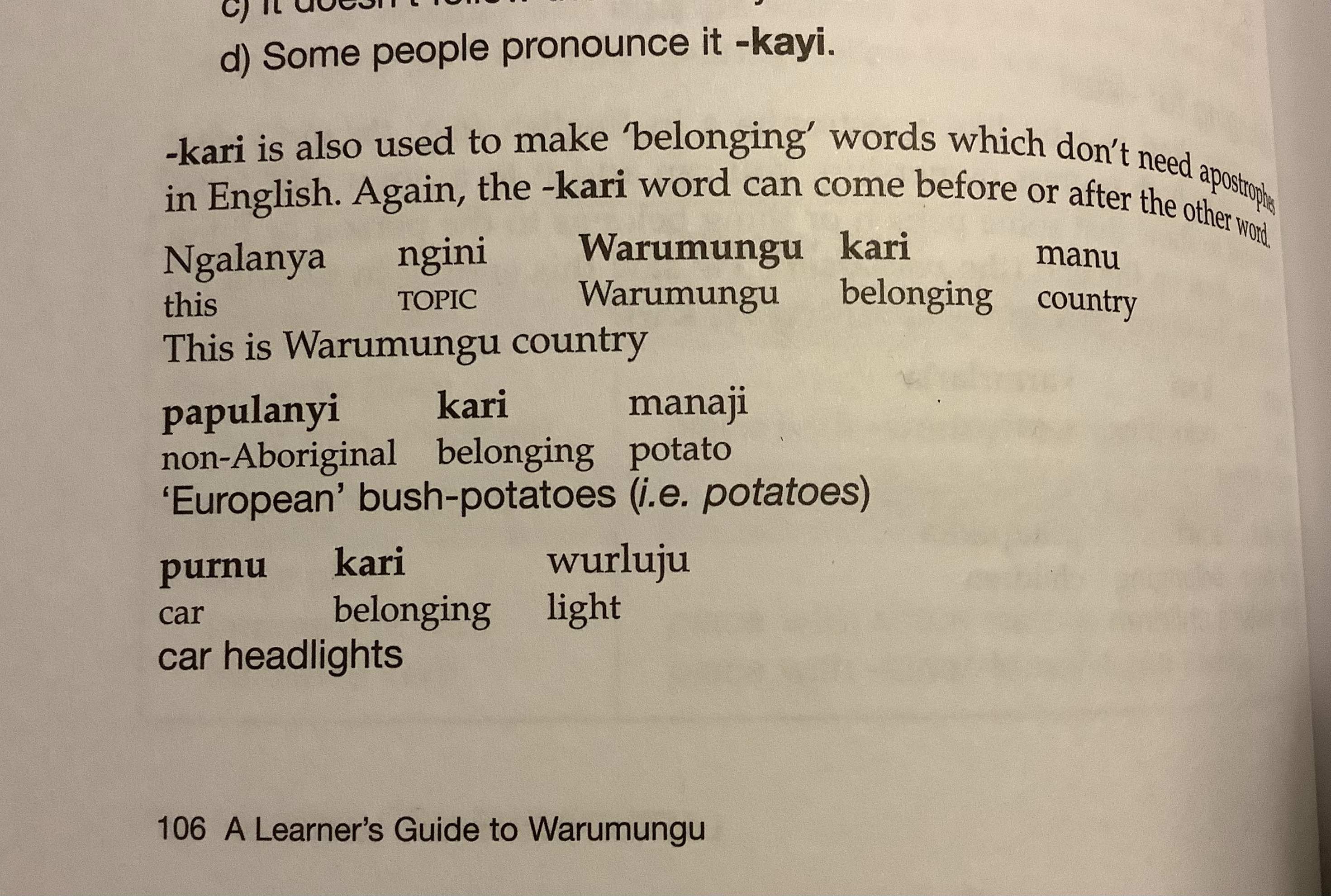
    My limited understanding of Warumungu language (First Peoples – Tennant Creek Barkly region, NT) gives:

    manu-kari for country-having

    manu-kupurtu for country-lacking

    We will need to ask Warumungu people if they agree to use these terms in a general sense.

    ‘A Learner’s Guide to Warumungu’ Compiled by Jane Simpson on behalf of owners of the Warumungu language. 2002. IAD Press.

    Solutions will emerge as we proceed … discussion on the Sahul Perspectives Facebook Group.

  • We are all in a process of Becoming …

    Jul 26th, 2022

    Sahul – Life Unstated

    I acknowledge the original Peoples of Sahul and their living descendants in what we presently call ‘Australia’ and ‘New Guinea’.

    Go to this Sway

  • Word soon spread …

    Jul 24th, 2022
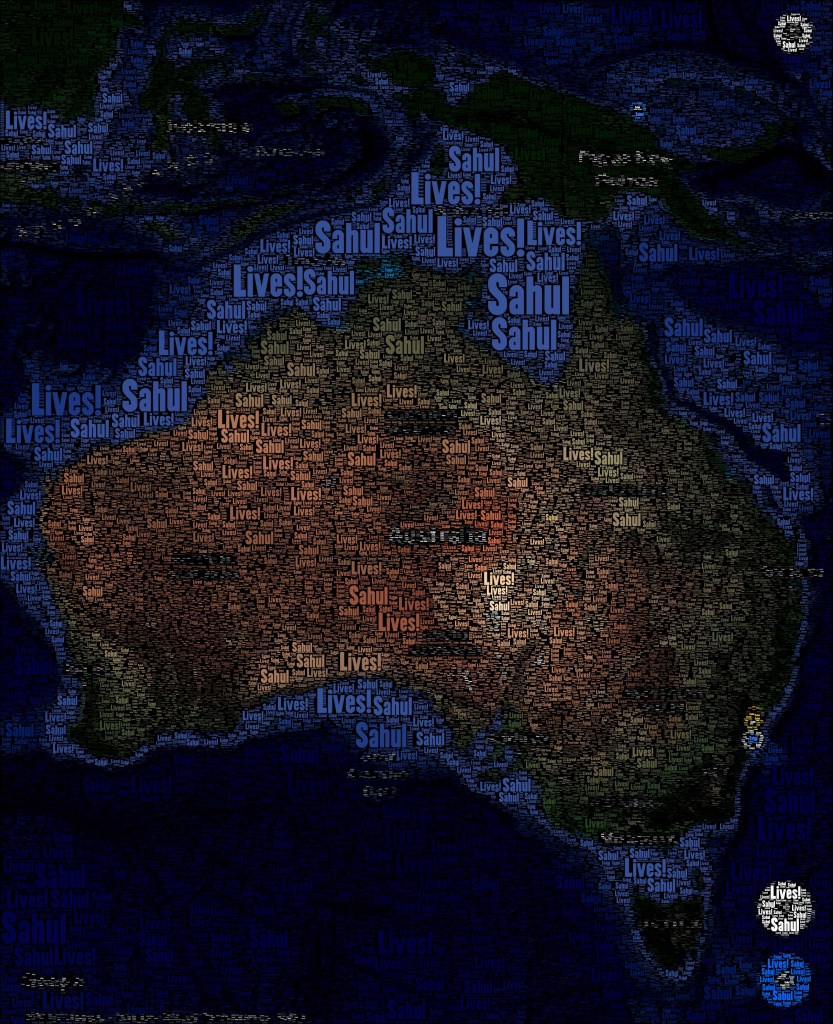
    Sahul lives!
←Previous Page
1 2 3
Next Page→

Blog at WordPress.com.


Loading Comments...
 

    • Subscribe Subscribed
      • People & Society
      • Already have a WordPress.com account? Log in now.
      • People & Society
      • Subscribe Subscribed
      • Sign up
      • Log in
      • Report this content
      • View site in Reader
      • Manage subscriptions
      • Collapse this bar