As part of the shift from a Northern hemisphere perspective to a Sahul perspective decolonising universities (at home and abroad) is a task for the 21st Century.
In this piece i look at the establishment of modern anthropology at the Australian National University. I share the draft here to stimulate discussion. See
Content note: this article mentions genocide and acts of colonial violence against Aboriginal people.
How long do you think stories can be passed down, generation to generation?
Hundreds of years? Thousands?
Today, we publish new research in the Journal of Archaeological Science demonstrating that traditional stories from Tasmania have been passed down for more than 12,000 years. And we use multiple lines of evidence to show it.
Tasmania’s violent colonial history
Within months of establishing a colonial outpost on the island in 1803, British officials had committed several acts of genocide against Aboriginal Tasmanian (Palawa) people. By the mid-1820s, soldiers, convicts, and free settlers had taken up arms to fight what became known as the “Black War”, aimed at capturing or killing Palawa and dispossessing them of their Country.
Tasmania’s colonial government appointed George Augustus Robinson to “conciliate” with the Palawa. From 1829 to 1835, Robinson travelled with a small group of Palawa, including Trukanini and her husband, Wurati. By 1832, Robinson’s “friendly mission” had turned to forced removals.
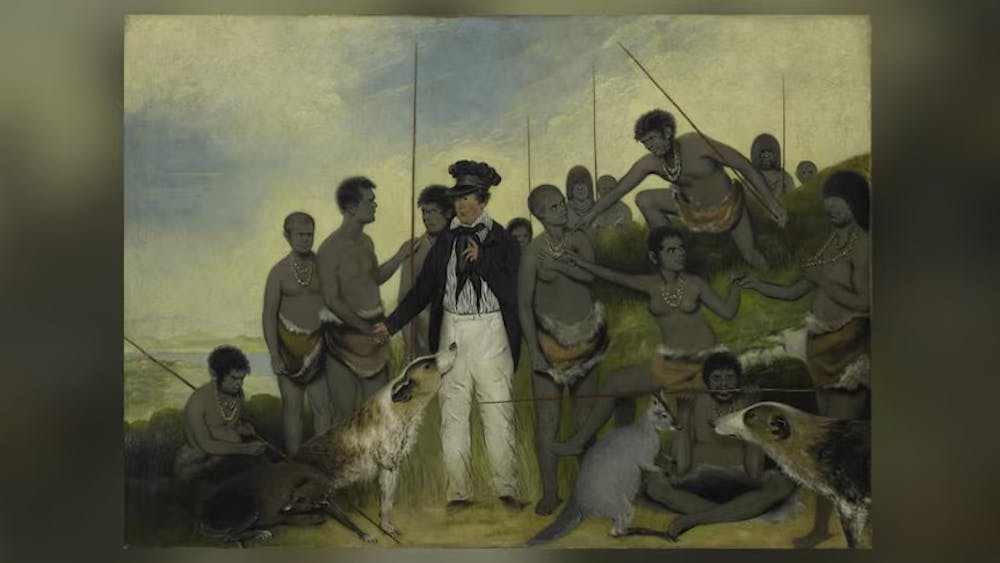
A postcard showing the (so-called) ‘Friendly Mission’, led by George Augustus Robinson (1941), colourised version. State Library of Victoria
Robinson kept a daily journal, which included records of Palawa languages and traditions. Over time, Palawa men and women slowly began to share some of their knowledge, explaining how their ancestors came to Tasmania (Lutruwita) by land from the far north, before the sea formed and turned their home into an island. They also spoke about the Sun-man, the Moon-woman, and a bright southern star.
These stories are of immense importance to today’s Palawa families who survived the devastating impact of colonisation, and who continue to share these unique creation stories. Through careful investigation of colonial records, and collaborating with Palawa knowledge-holders, we found something remarkable.
Rising seas and the formation of Lutruwita
Over the past 65,000 years, Australia’s First Peoples witnessed natural disasters and significant changes to the land, sea and sky. Volcanoes spewed fire, earthquakes shook the land, tsunamis inundated the coastlines, droughts plagued the continent, meteorites fell to the earth, and the stars shifted in the night sky.
Some 20,000 years ago, the world was in the grip of an ice age. Australia was conspicuously drier than it is today, and the ocean was significantly lower. All of that sea water was bound up in glaciers that swathed vast tracts of land, particularly across the Northern Hemisphere, and polar ice caps much larger than ours today.
As time passed, temperatures gradually rose and the ice began to melt. After 10,000 years, the sea level had risen 125 metres; a process that dramatically transformed coastlines and submerged landscapes that had been ancestral Country for thousands of generations. This forced humans to change where and how they lived.
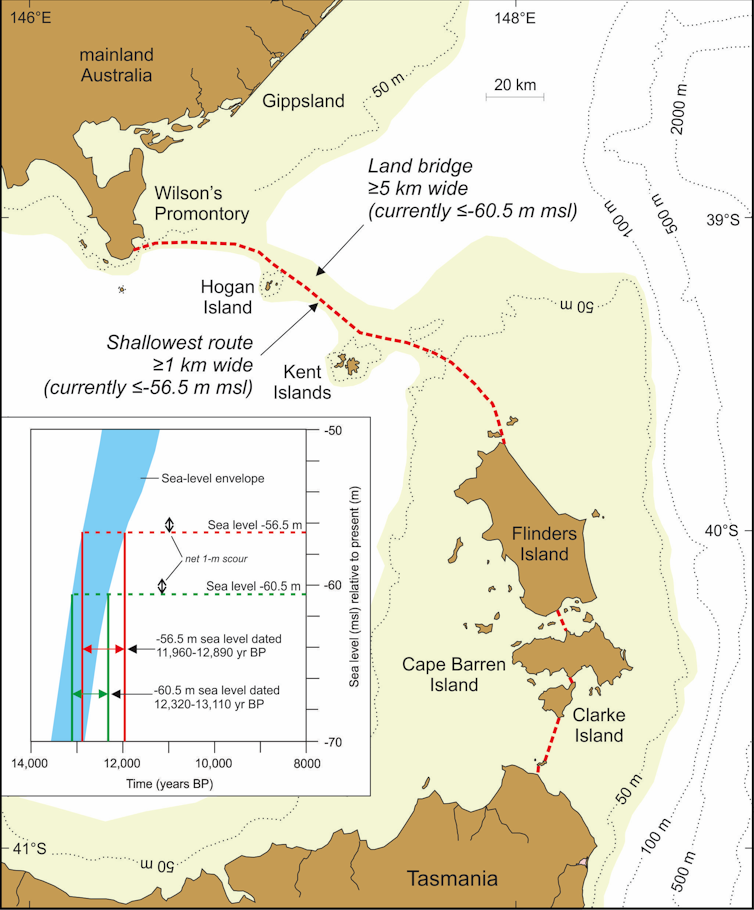
During the ice age, both Lutruwita and Papua New Guinea were connected to mainland Australia by dry land, forming a landmass called Sahul. As the seas rose, Tasmania’s connection gradually narrowed to form what geologists call the Bassian Land Bridge.
A topographic map of the Bass Strait, showing the conditions before the Bassian Land Bridge was submerged. The yellow shaded area represents geography of the land bridge, while the broken red line indicated the last vestige of a continuous Bassian Land Bridge between Tasmania and the mainland. Patrick Nunn, Author provided
People continued to live on this “land bridge”, but by 12,700 years ago it had narrowed to just 5 kilometres wide (lime-green shading on the map above). Habitable land was gradually reduced as the sea closed in. Less than 300 years later, the “land bridge” was gone and Lutruwita was completely surrounded by water.
Palawa traditions from that time survived hundreds of generations of retelling, forming part of a larger canon of Aboriginal and Torres Strait Islander stories around Australia. They described rising seas and submerging coastlines as the ice sheets melted before levelling off around 7,000 years ago. Stories of similar antiquity are known from other parts of the world.
A great south star
Aboriginal and Torres Strait Islander cultures developed rich and complex knowledge systems about the stars, which are still used today. They describe the movements of the Sun, Moon, and stars, as well as rare cosmic events, such as eclipses, supernovae, and meteorite impacts.
In the 1830s, a Palawa Elder spoke about a time when the star Moinee was near the south celestial pole. He laid down a pair of spears in the sand and drew a few reference stars to triangulate its position.
Colonists seemed perplexed about the presence of an antipodean counterpart to Polaris, as no southern pole star exists today. Some tried to identify the stars on the star map, but seemed confused and labelled them incorrectly, as they were unaware of an important astronomical process called axial precession. https://www.youtube.com/embed/2JJjNc1xPKw?wmode=transparent&start=0
As the Earth rotates, it wobbles on its axis like a spinning top. This shifts the location of the celestial poles, tracing out a large circle every 26,000 years. As thousands of years pass by, the positions of the stars in the sky slowly change.
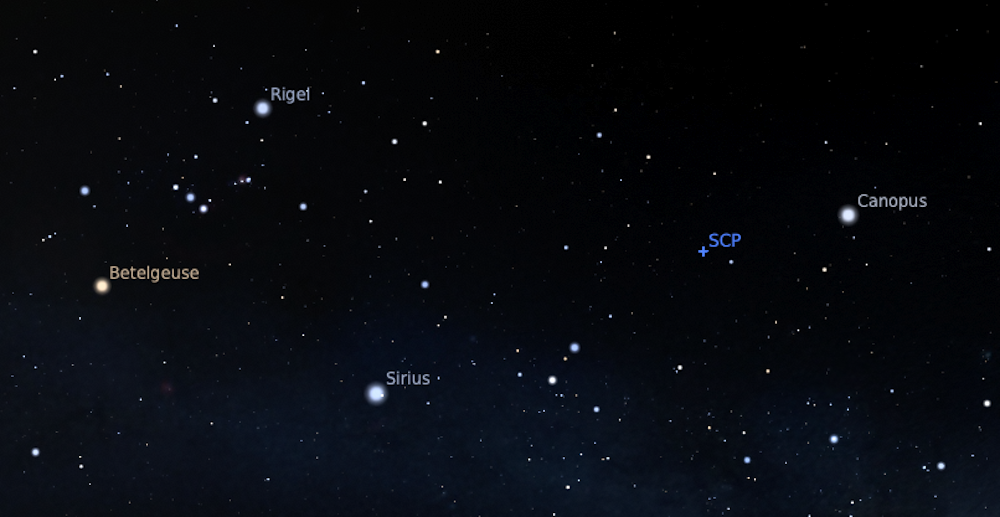
Long ago, Canopus was at its southernmost point in the sky. Lying just over 10 degrees from the south celestial pole, it appeared to always hover in the southern skies each night. That last occurred 14,000 years ago, before rising seas turned Lutruwita into an island.
Stars in the southern sky as they would have appeared 14,000 years ago, accounting for precession, nutation, and proper motion. Canopus is very close to the south celestial pole (SCP). Stellarium, CC BY
Exciting collaborative futures
We can see through independent lines of evidence that Palawa stories have been passed down for more than twelve millennia. We also find here the only example in the world of an oral tradition describing a star’s position as it would have appeared in the sky over 10,000 years ago.
Our investigation of colonial records that record traditional systems of knowledge has demonstrated a powerful cross-cultural way of better understanding deep human history. This also recognises the immense value of Aboriginal and Torres Strait Islander traditions today.
This research was co-authored by graduate Michelle Gantevoort from RMIT University, and student researchers Ka Hei Andrew Law from the University of Melbourne and Mel Miles from Swinburne University of Technology.
In this piece of work i write about developing a healing Sahulian perspective when conceptual craftspeople fashion representations of First Peoples. Peoples-and-countries are one.
There needs to be representational justice for First Peoples to ensure an adequate definition of their realities. According i reject the idea that agriculture, as commonly understood, provides the only privileged base from which we can interpret our human story.
I argue here that First Peoples in ‘Australia’ did not move to agriculture as they remain in good faith with an ‘eternal life design’. Moving to horticulture would result in a lower level of Being.
Co-existing forms of knowledge are required in respect to the ‘science’ – ‘traditional knowledge’ debate.
This is especially import so proper understanding of First Peoples Ways can assist in the vital task of moving from a ‘hot’ society’ to, as least, a cooler one by learning from indigenous sources.
The issue of what happened in New Guinea, as part of Sahul, requires another chapter.
Bruce Reyburn – Coledale NSW
If the link does not work for you contact me at sahulman@sahul.online and i’ll get something which does.
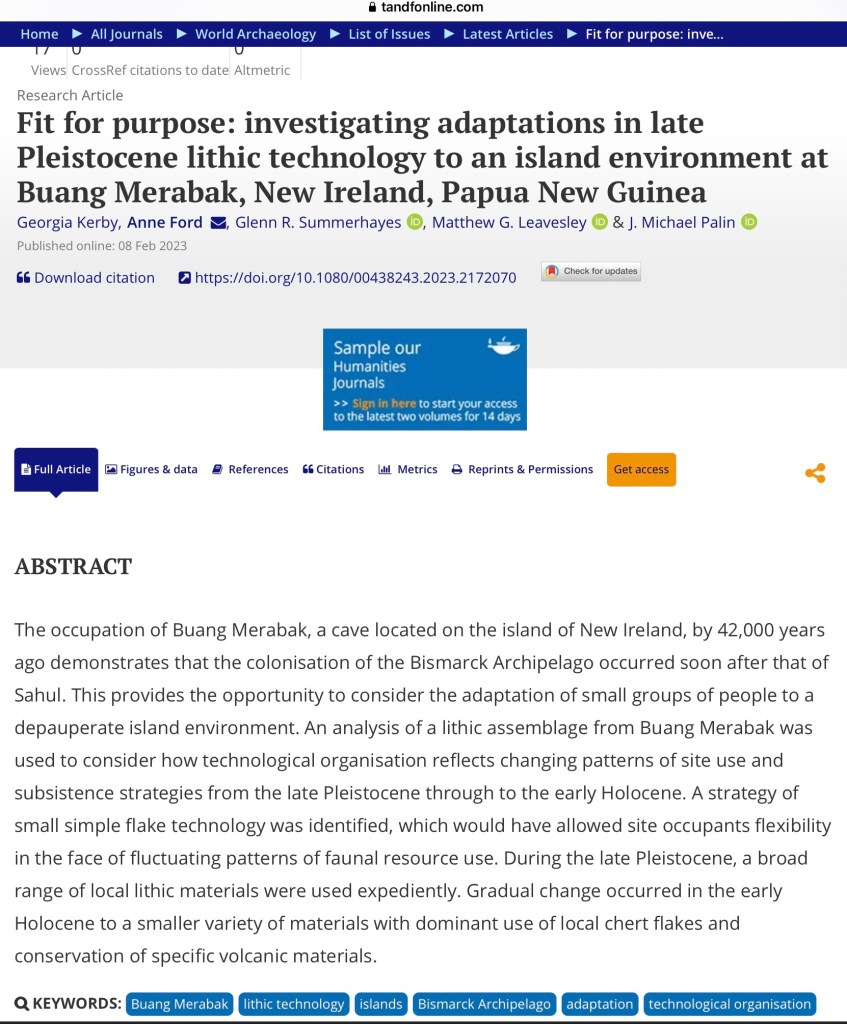
Sahul (the supercontinent formed by New Guinea and Australia at times of lower sea level) was peopled by 65,000 ± 5,700 years ago, but secure archaeological evidence for occupation before ~25,000 years ago on the eastern seaboard of Australia has proven elusive. This has prompted some researchers to argue that the coastal margins remained uninhabited prior to 25 ka. Here we show evidence for human occupation beginning between 30 ± 6 and 49 ± 8 ka at Wallen Wallen Creek (WWC), and at Middle Canalpin Creek (MCA20) between 38 ± 8 and 41 ± 8 ka. Both sites are located on the western side of Minjerribah (North Stradbroke Island), the second largest sand island in the world, isolated by rising sea levels in the early Holocene. The earliest occupation phase at both sites consists of charcoal and heavily retouched stone artefacts made from exotic raw materials. Heat-treatment of imported silcrete artefacts first appeared in sediment dated to ~30,000 years ago, making these amongst Australia’s oldest dated heat-treated artefacts. An early human presence on Minjerribah is further suggested by palaeoenvironmental records of anthropogenic burning beginning by 45,000 years ago. These new chronologies from sites on a remnant portion of the continental margin confirm early human occupation along Sahul’s now-drowned eastern continental shelf.
Huettmann, F. (2023). In Bed with a Big Bad Neighbor for Life: The Middle Power of Australia as a Domestic, Cultural, Political, Material and Environmental Sustainability Problem for Papua New Guinea and Beyond?.
In: Globalization and Papua New Guinea: Ancient Wilderness, Paradise, Introduced Terror and Hell. Springer, Cham.
Looking at the big floods in the Gulf Country at this time brings to mind the lake which once occupied part of Sahul now under sea water.
“The Gulf and adjacent Sahul Shelf were dry land at the peak of the last ice age 18,000 years ago when global sea level was around 120 m (390 ft) below its present position. At that time a large, shallow lake occupied the centre of what is now the Gulf.” https://en.wikipedia.org/wiki/Gulf_of_Carpentaria (accessed 14 March 2023.
“When sea level began to rise after about 12,000 BP, it began having an effect on the lake, a permanent open connection to the sea forming, though between about 12,000 to 8,000 BP it apparently remained as a low salinity water body, partly because the Arafura sill allowed only limited exchange with the ocean, and partly because of the monsoonal conditions with tropical cyclones dumping large amounts of rain on the catchments that drained into the lake. The present Torres Strait was formed as the land bridge between the Australian mainland and the previously connected New Guinea was completely flooded, after which the lake was swamped by the rising sea. Unlike many Australian lakes, Lake Carpentaria never became a dry playa at any time throughout its existence.” M. H. Monroe https://austhrutime.com/lake_carpentaria.htm
In New Guinea, low elevations are thought to be dominated by plant species with biogeographic origins in Sunda (Borneo, Sumatra, Java, Mainland Asia) and high elevations by species from Sahul (Australia and New Guinea).
In regions where frequent surveys of the flora are unfeasible, herbarium specimens collected over time offer an opportunity to study the co-occurrence of species. Over 7000 collections have been made on New Guinea’s Mount Jaya allowing us to examine species presence under current and future temperatures.
Applying a Bayesian phylogenetic mixed effects model to the Mount Jaya elevation gradient, we show that species of Sunda origin are more likely to occupy warmer lowlands and Sahul species cooler higher elevations.
Using the model to predict species distributions under a 2 °C increase, we find that Sahul species are less likely to tolerate future temperatures, especially below 1000 m. Predictions also show a potential increase in species richness across the gradient. It is unclear if these increases are possible due to limits imposed by the species area relationship.
Synthesis: These results emphasize how biogeographic origin influences current and future species distributions on tropical mountains. It remains to be seen how our results link to traits that dictate species’ ability to tolerate increasing temperatures.
“New dates suggest Oceania’s megafauna lived until 25,000 years ago, implying coexistence with people for 40,000 years” Michael Westaway, The Conversation.
”We compared the genomes of Papuan people to those of Aboriginal Australians, and discovered that these two populations are actually strikingly distinct from each other. Surprisingly, Papuans and Aboriginal Australians appear to have diverged from each other at least 25,000 years ago, even though the landmasses of Australia and New Guinea were only separated by rising sea levels less than 10,000 years ago.”
Anders Bergström A first author on the paper from the Sanger Institute
Peoples-with-countries contrasts with Peoples-without-countries.
The social distinction between autochthonous and immigrant peoples is a recurring theme in recent Sahul life.
“The root of the word autochthonous traces back to the Greek word autokhthon, meaning literally “sprung from the land itself”.
‘Allochthonous’ is its counterpart – ‘originating elsewhere’.
In comparison with autochthonous (from the earth) the Dutch have an expression ‘Allochtoon’ which relates to immigrants and the descendants of immigrants.
“Allochtoon (plural: allochtonen) is a Dutch word (from Greek ἀλλόχθων, from ἄλλος [allos] other and χθών [chthōn] soil/earth/land), literally meaning “emerging from another soil”.
Autochthonous has deeper existential dimensions than ‘indigenous’. The sense of ‘autochthonous’ required to do justice in Sahul carries with it affirmation of the extremely long period and relationships which have resulted in living people today.
These living people come from their ancestors – as mapped and represented in their cosmologies and systems of signification. In Central Australia, for example (and in shorthand) from Dreamings.
Present uses of the term ‘indigenous’ do not do the job required for representational justice.
The word ‘autochthonous’ – a difficult word – will have to serve as a space holder until we gain a new vocabulary from our cultural partners.
‘Allochtoon’ ‘Immigrant’ and ‘Settler’ are all problematic as well. How to fashion a figure with a migration background, without introducing unnecessary divisiveness?
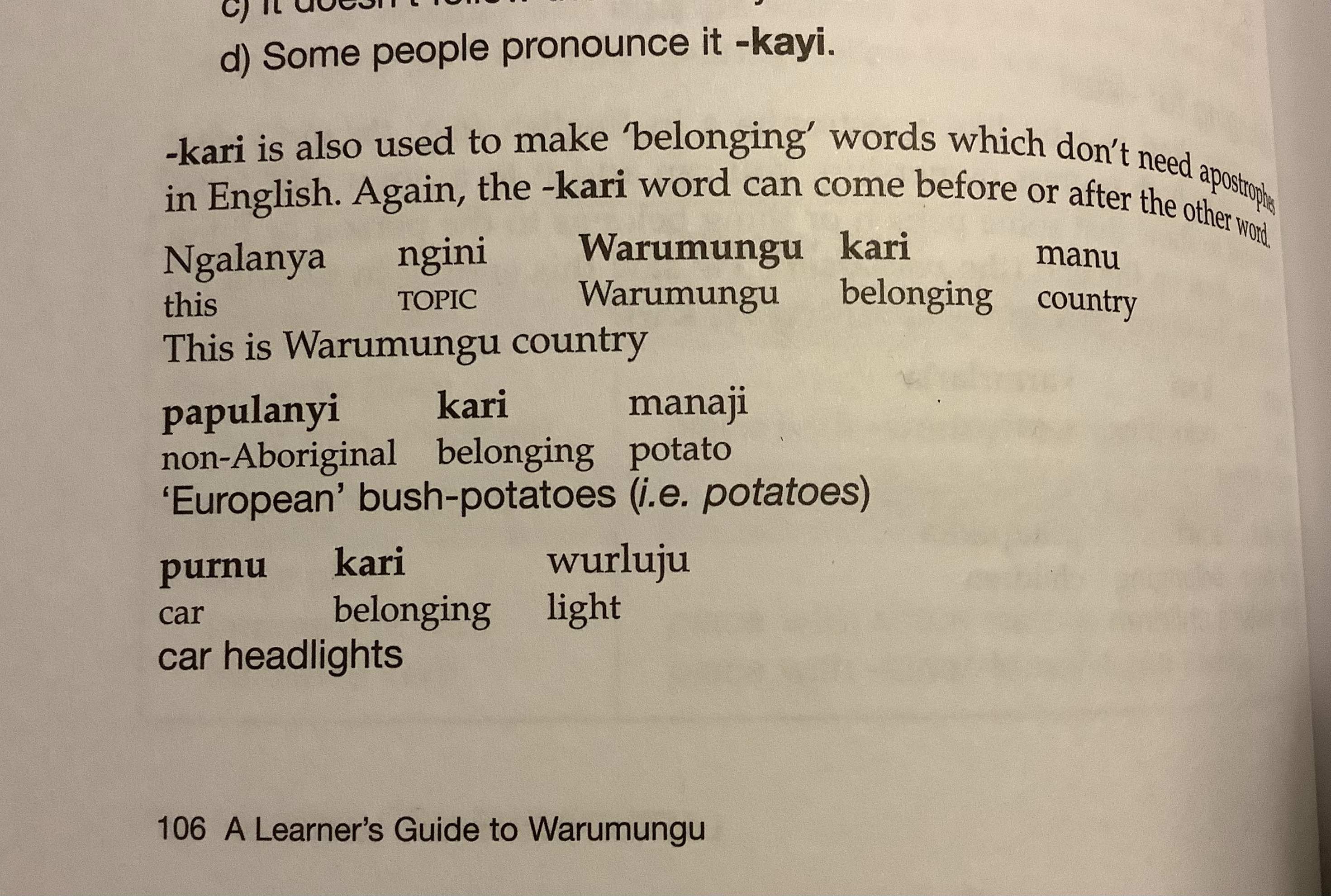
My limited understanding of Warumungu language (First Peoples – Tennant Creek Barkly region, NT) gives:
manu-kari for country-having
manu-kupurtu for country-lacking
We will need to ask Warumungu people if they agree to use these terms in a general sense.
‘A Learner’s Guide to Warumungu’ Compiled by Jane Simpson on behalf of owners of the Warumungu language. 2002. IAD Press.
Solutions will emerge as we proceed … discussion on the Sahul Perspectives Facebook Group.
Fashioning Sahul perspectives raises many questions and issues which will need to be explored and resolved.
We are now in a period like that when creative painting had similar concerns with higher matters, perspective and ways of seeing. And were tackled by enthusiastic artists.
A Covenant exists between original First Peoples and creation.
One key point for Sahul perspectives is that there is an unbreakable link between original Sahul Peoples and their living countries. Peoples-and-countries constitute a fundamental unity.
When this link is denied – in thought and in lived practice – damage is done to the fabric of life.
Caring for country is caring for eternal soul – Country is a generative cosmic context. Land is life. Their Ways are well-earthed.
This results in representational challenges both in terms of how we fashion well-formed images of life and how First Peoples are represented politically vis-à-vis the State.
We have to add contemporary political spin for a whole picture.
Original Sahul Peoples are presently captive within nation-states (PNG is a special case). We have to factor in their struggle to fashion accurate representations.
Faulty Acts of Parliaments – rooted in profound bad faith – cannot extinguish original Peoples relationships which are transcendental in origin.
States seek to ‘fix’ relationships between signifier and signified. States are blocked forms of relating. Life flows.
Drawing on Sahul peoples ways, rather than European nation-state specifications, co-existing sovereignty provides possible scope for healing governance solutions.
Good faith and acts of genuine high-level exchanges of things of real value are required to provide sound foundations for all of life in both Australia and New Guinea … and beyond.
We are not there yet. We are in a process of becoming
We acknowledge the original peoples of Sahul and their living descendants in Australia and New Guinea.
This website is intended to work on developing perspectives on life from our understanding of the Ways of First Peoples in Australia and New Guinea.
In his Chairman’s address to the 4th Conference of the European Society for Oceanists (Leiden 25 June 1999) the late Dutch Anthropologist Jan Pouwer spoke of a Sahul ‘epistemological-ideological shift’ which:
… elevates … Australia, New Guinea and Western Melanesia from a receptive periphery of Island Southeast Asia to an active and creative centre of its own.
Pouwer 1999
An active and creative centre quite different to that of the Western European tradition. The research of scholars support the strong political statements of Sahul’s living peoples that “Land is Life”.
It is as though, when people first emerged in Sahul there were two brothers (Earth-Beings) and their families – Elder Brother and Younger Brother. They spread out over the vast new country. After the country became fully peopled – after 40,000+ years – the sea rose and cut off the two brothers. Sahul was divided into what we call Australia and New Guinea.
In Australia peoples-and-countries form a fundamental unity. Elder Brother remained true – and in good faith – to an eternal life design. Ceremonies were directed at ensuring life reproduced itself in an orthodox manner and that the cosmos remained well-tempered. These are the Ways of Elder Brother and his family.
The situation in New Guinea is more nuanced as a result of the experiments with ‘neolithic’ ways – horticulture, animal husbandry, village life. The underlying connection with country remains a powerful force in their lives. They constantly seek to keep these new ways and life in balance. These are the Ways of Younger Brother and his family.
In Europe people underwent a split in their Being – resulting in Human and Humus. When this fundamental unity is ‘spilt’ – conceptually and/or in practice – damage is of done to the fabric of life.
The chaos introduced into European life by the split in Being eventually resulted in their arrival into the lives of Sahul peoples and spreading chaos into the well-ordered lives and countries of First Peoples
Life is a complex cosmic balancing act. It is as though the contact of European life with Sahul posits a global healing challenge – reconnecting unearthed European practices. Care for the soul and care for the soil are two sides of the one story.
Starting from the position that First Peoples lives are the country is a necessary initial step. How we new arrivals treat them is how we treat the country we find ourselves in.
Developing Sahul perspectives is part of how this – the greatest of life’s stories – unfolds. We are in a process of becoming.
 People & Society